· software development · 22 min read
2025 in Review
I started a podcast, posted everyday on social media, and spoke at conferences, here are the results and learnings I got from each of them.

Neciu Dan
Hi there, it's Dan, Senior Engineering Manager at Perk, host of Señors at Scale - a podcast for Senior Engineers, Organizer of ReactJS Barcelona meetup, and international speaker, I'm here to share insights on combining
technology and education to solve real problems.
I write about startup challenges, tech innovations, and the Frontend Development.
Subscribe to join me on this journey of transforming education through technology. Want to discuss
Tech, Frontend or Startup life? Let's connect.
2025 in Review
What a year, huh?
I didn’t realize that the year was over until Christmas came about. Then it hit me: It’s December already? I could have sworn we were still somewhere in March, getting ready for Easter. But jokes aside, this year has truly been different. All year, it felt like no time was passing at all; then, in a blink, I was transported a couple of months into the future.
Maybe the reason for this was the goals that I set for myself at the end of 2024:
- Post every day on social media
- Start a podcast
- Start a newsletter
- Speak at a specific number of conferences
- Organize a particular number of meetups
- Make YouTube videos
- Write an article per month
- Don’t get fired
- Don’t get divorced by working too much
And happy to say I accomplished all of them, with varying degrees of success. In this article, I want to go in-depth about my learnings from each goal that I set myself.
(Except for the divorce part, for some reason, my wife still loves me; I don’t know what I’m doing right.)
More than 1,000,000 members reached, now what?
One of my goals for the year was to increase my follower count on different social media platforms. I don’t remember the exact numbers I had at the beginning of the year on all platforms, but on LinkedIn, it was around 4k followers and connections.
This part focuses more on LinkedIn because, despite posting daily on Twitter (X) and BlueSky, a lack of engagement there led me to abandon daily updates after a month.
I also tried different ways to post on Instagram and TikTok, with only small results; more on this later, when we talk about videos.
But LinkedIn was my one success on this; I went from 4k followers to 10k+ with multiple posts going viral and getting a lot of recognition.
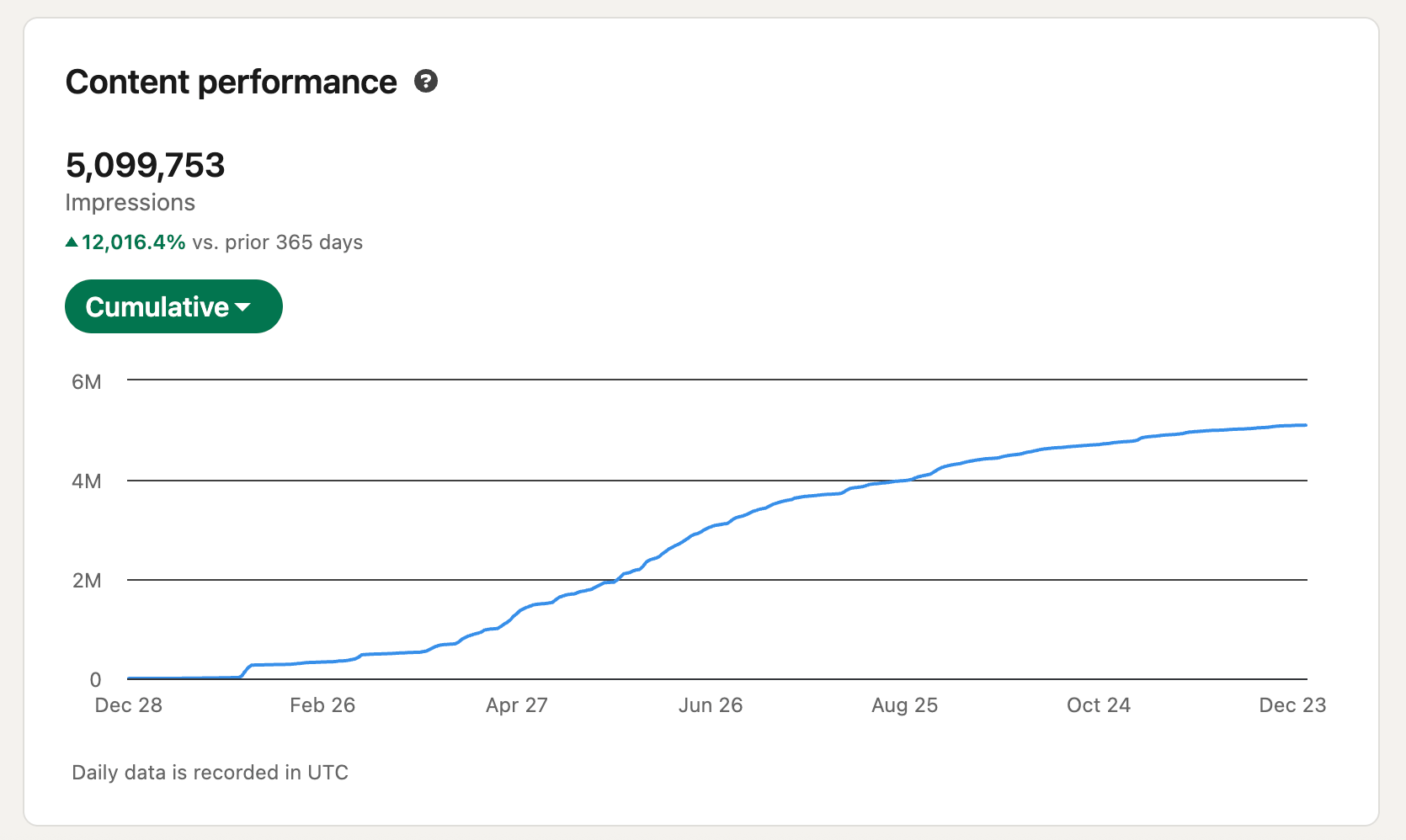
In a year, my posts generated around 5M impressions and reached around 1M unique users.
As you can see from the graph, it took a while for my content to take flight, mainly because in the first couple of months, I was still trying to find my voice, writing style, and discover what people wanted to read.
Initially, I planned to write about nerdy things, such as algorithms, stoplight functionality, airline boarding strategies, and all sorts of weird computer science topics.
That didn’t work.
Eventually, by trying different things, I found out what worked better: a couple of posts on JavaScript functionality and new stuff from the JS ecosystem.
From there, I got my first viral post (which is still my most popular) by touching on a sensitive subject: the so-called Provider Hell in the React ecosystem.
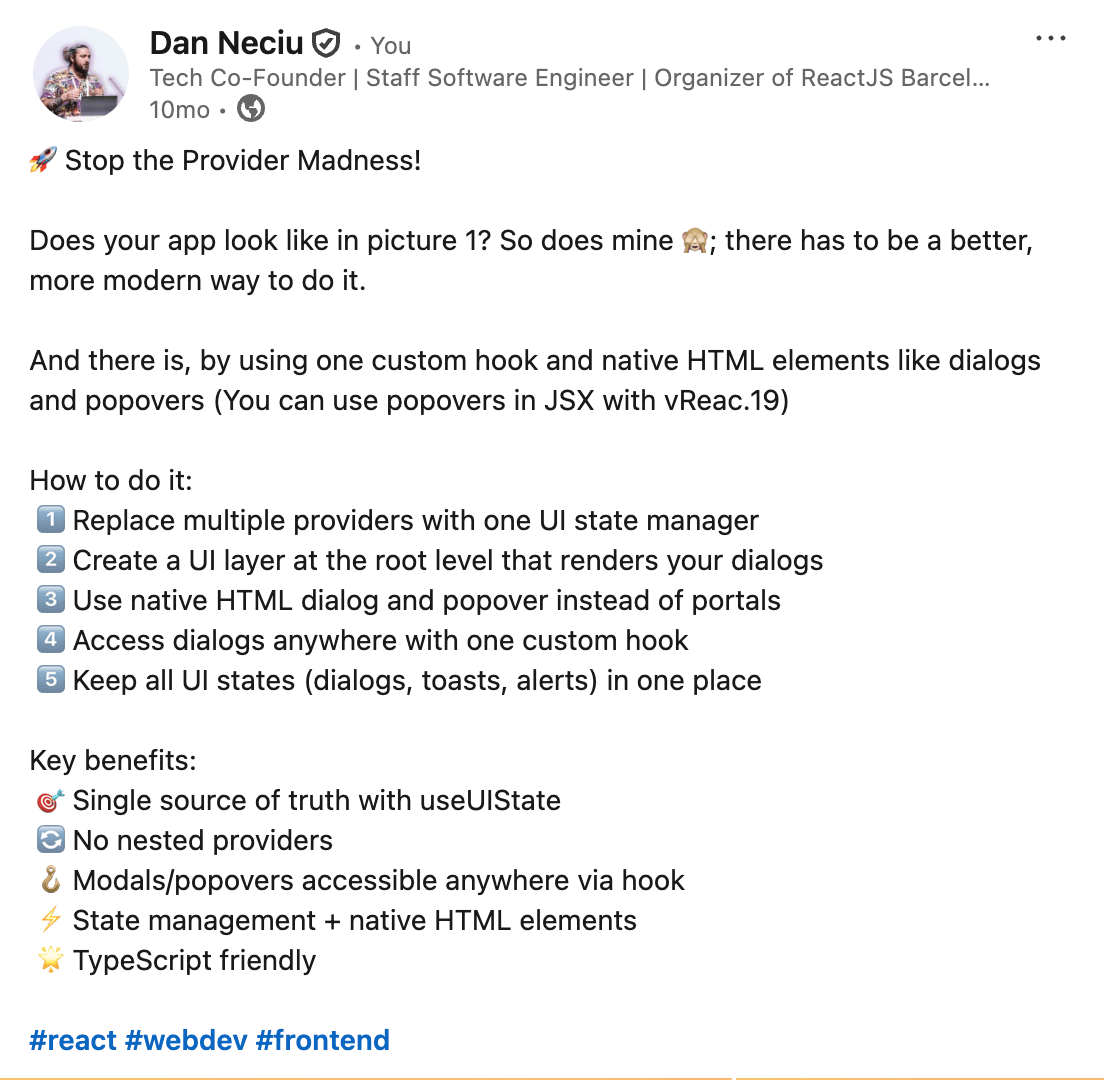
I got around 250k impressions and a lot of comments, most of which disagreed with what I was saying.
At this point, I realized what I needed to post about and made it a practice to always be on the lookout for new things in the JS and React ecosystem. I would save articles from prolific authors, check out new releases to famous libraries like Tanstack, and follow the Mozilla docs and Chrome Developer blogs for updates.
Or if something extraordinary happened at work, I would write about it. Typically, I would save everything in a WhatsApp group where I am the only member, and on Sundays, I would spend the first couple of hours of the morning scheduling my LinkedIn posts.
There are various platforms to automate this more effectively, such as Buffer and SocialBee. I tried them all, but still, they didn’t work well for tagging, commenting, link previews, or other functionality I really needed, so I post directly on LinkedIn by scheduling the content in advance.
I also experimented with different images, links, videos, and other formats to see what works and what doesn’t.
Here is what I found:
-
✅ The first two lines are the most important; keep them short and catchy, and, for me, a question always works best.
-
⛔ Do not add links to the post, as soon as any link is added, reach goes down significantly. My average post gets 5k impressions, but when I add a link, it gets stuck at 500 impressions.
-
✅ Tagging people helps, such as article authors or companies that have been mentioned in the article.
-
⛔ Video content has not worked for me at all. I may not be good at making videos, or my audience may not be the Gen Z TikTok audience. My LinkedIn videos never get above 500 impressions.
-
✅ I like to add code as a feature image. In the code, I add comments explaining what is happening, since most people do not expand the post and just scan the photo and comment based on that and the post’s hook.
-
⛔ Reposting my own post does not work or drive any significant increase in impressions and seems to hurt my post.
-
✅ Adding a comment with the source of my content, then another with my newsletter links, works quite well. I also like to include the article’s source in the image to give props to the author. (Even if the author is a Reddit post, I got a little in trouble when someone pointed out on Reddit that I was stealing some code from someone else in another post – even though I wasn’t)
-
⛔ Do not use AI-generated images
-
✅ I rate myself on the best content I have for the week, and I post my highest-rated on Wednesday, then Tuesday, then Thursday. I always post early in the morning, 8 AM BCN time or 9 AM BCN time (I alternate exact minutes)
-
⛔ I do not post any content on Weekends; I reserve those spots for advertising my own podcast, newsletter, articles, or conference appearance. I post the link directly because, with or without it, these usually don’t pass 400 impressions
-
✅ Posting on Mondays was give or take based on the content, so I reserved that spot for my podcast announcement
There are also some caveats: if you check my daily impressions and non-cumulative followers, my numbers have been going down since late summer. Initially, I suspected that it was summertime, with people on vacation, that sort of thing. Still, once September rolled in and the numbers stayed flat, I realized LinkedIn had changed its feed algorithm.
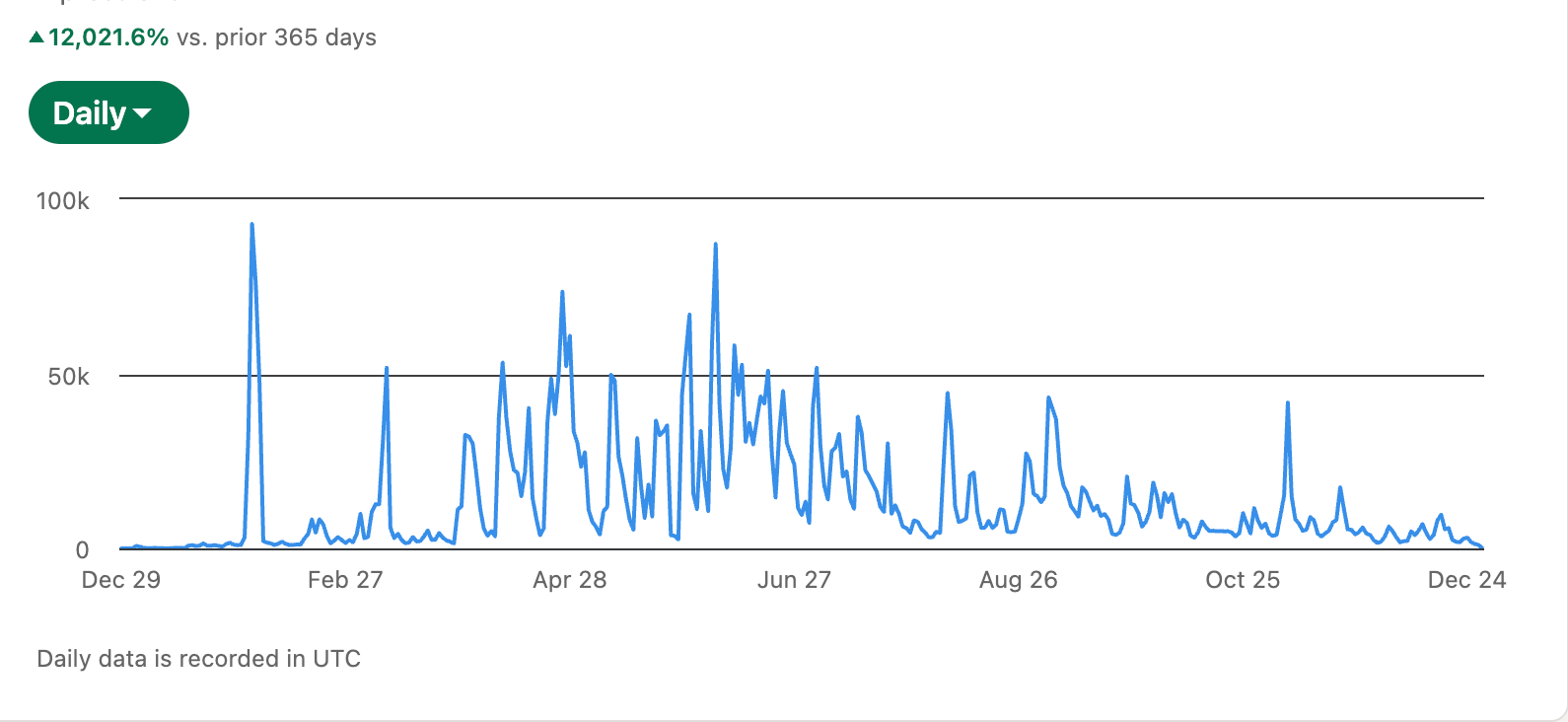
This drop in activity very much coincided with LinkedIn releasing the ability for anybody to boost their content (similar to what Instagram and TikTok have) – before only companies could increase their post.
I played around with boosting as well to see the results, and for like 5000 impressions and 10 clicks, you have to pay around 50$, which for me was not worth it as my average was still around 10k per post.
All in all, super happy with how posting on LinkedIn went in 2025, very disappointed with TikTok, Instagram, and BlueSky, where I tried to re-post my best content but in that platform’s style and got close to zero engagement.
I am going to continue posting on LinkedIn every day, aiming to reach 20k followers by 2026.
If you want to check out my content and give me a follow, check me out here.
On Meetups and Conferences
ReactJS Barcelona Meetup
Many 2024 decisions came to fruition this year. The most significant was my plan to take over the ReactJS Barcelona meetup. The meetup had been dead for the last 5 years; the previous event was in 2017, and I felt like the community could be rejuvenated with some fresh blood and good talks.
I originally planned to host them at my company (CareerOS) ‘s small office. I bought some chairs on Amazon, a TV, and had a small budget for pizza and drinks.
Little by little, the meetup grew, and we were getting more interest than could fit in the CareerOS office, so I started reaching out to companies in Barcelona to gauge their interest in hosting.
Mostly to friends and fellow developers at those companies. Huge thanks to Dynatrice, Lodgify, N26, Preply, and, of course, CareerOS for supporting the ReactJS community and bringing over 500 developers together in 2025.
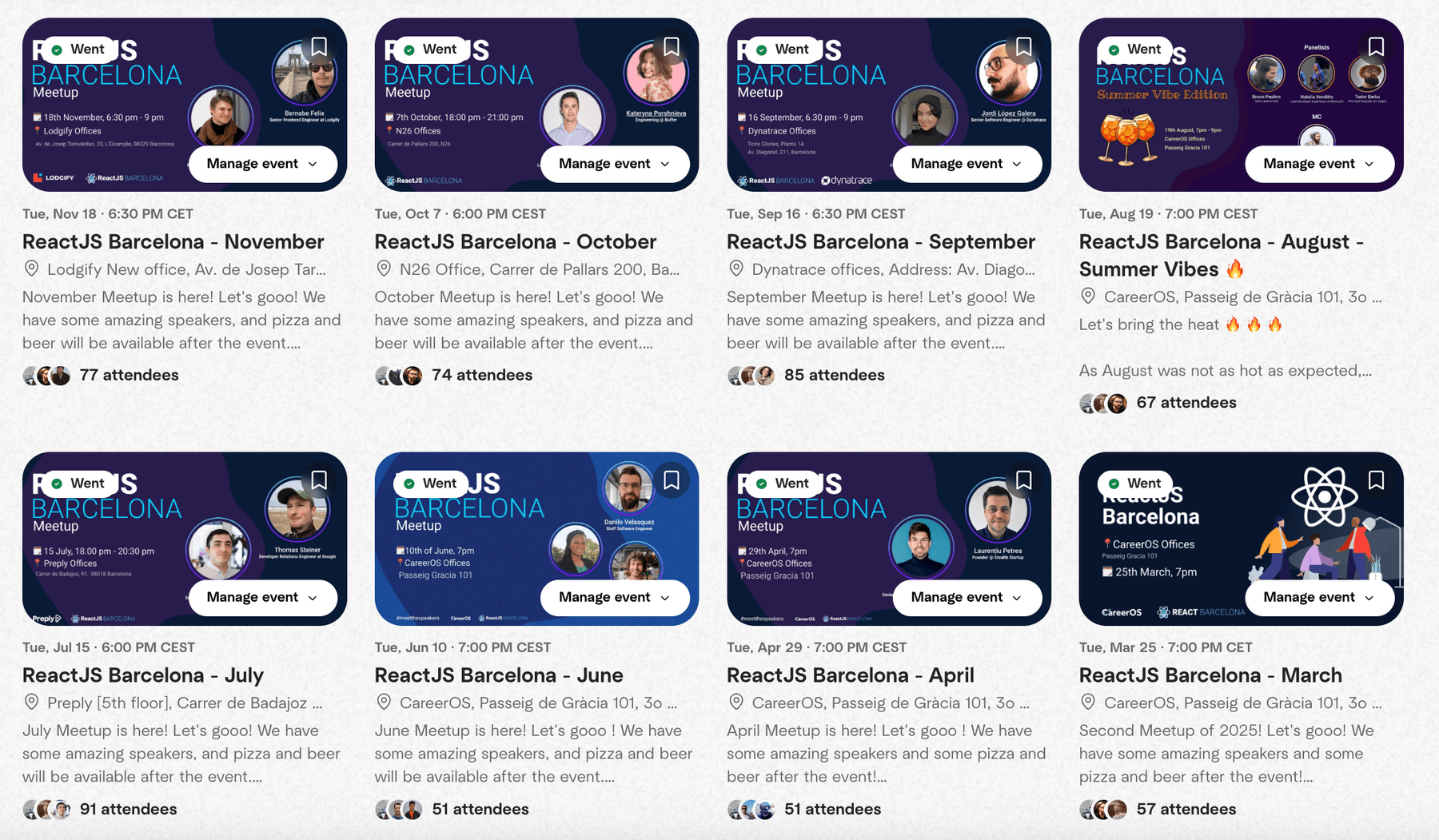
I originally planned to hold one meetup per month, for a total of 12 in 2025, but I only managed nine due to my schedule and difficulty finding speakers or a venue.
The most significant learning for me from the meetup was the joy of talking with people and seeing them at every event, plus the skill I gained from reaching out to different people to host and speak at the meetups, a skill I honed and used in my podcast guest acquisition as well.
Huge thanks to the outstanding speakers who decided to share some knowledge with the community and made all the meetups possible:
- Breno Oliveira
- Martí Serra Molina
- German Quinteros
- Alvaro Ritorto
- Laurentiu Petrea
- Daniel Coll Leal
- Danilo Velasquez
- Rashan Smith
- Utku Can Ozturk
- Thomas Steiner
- Claudio Orlandi
- Bruno Paulino
- Tudor Barbu
- Natalia Venditto
- Yasminn Vaz
- Jordi López Galera
- Asier Aduriz Saiz
- Kateryna Porshnieva
- Oscar Andell
- Bernabe Felix
Huge thanks to all of them for sharing their knowledge with the community and making all the meetups possible.
If you are based in Barcelona or planning to travel and want to speak at ReactJS Barcelona meetup, or if you’re going to host a meetup at your HQ, hit me up on LinkedIn and let’s make it happen.
My goal for 2026 stays the same: to organize twelve meetups, one per month! 🎊 🎊 🎊 If you want to be part of our community, feel free to follow us on LinkedIn and join our Discord server.
Speaking at Conferences
Another big decision from 2024 was to limit my conferences for next year. In 2024, I spoke at 10 conferences across Europe and the USA, including major ones such as KCDC, React Rally in Utah, and C3 Dev Fest in Amsterdam. I had a wonderful time and met so many great speakers and attendees, but traveling to so many places took a toll on me, and I wanted to limit my travel to 6 conferences.
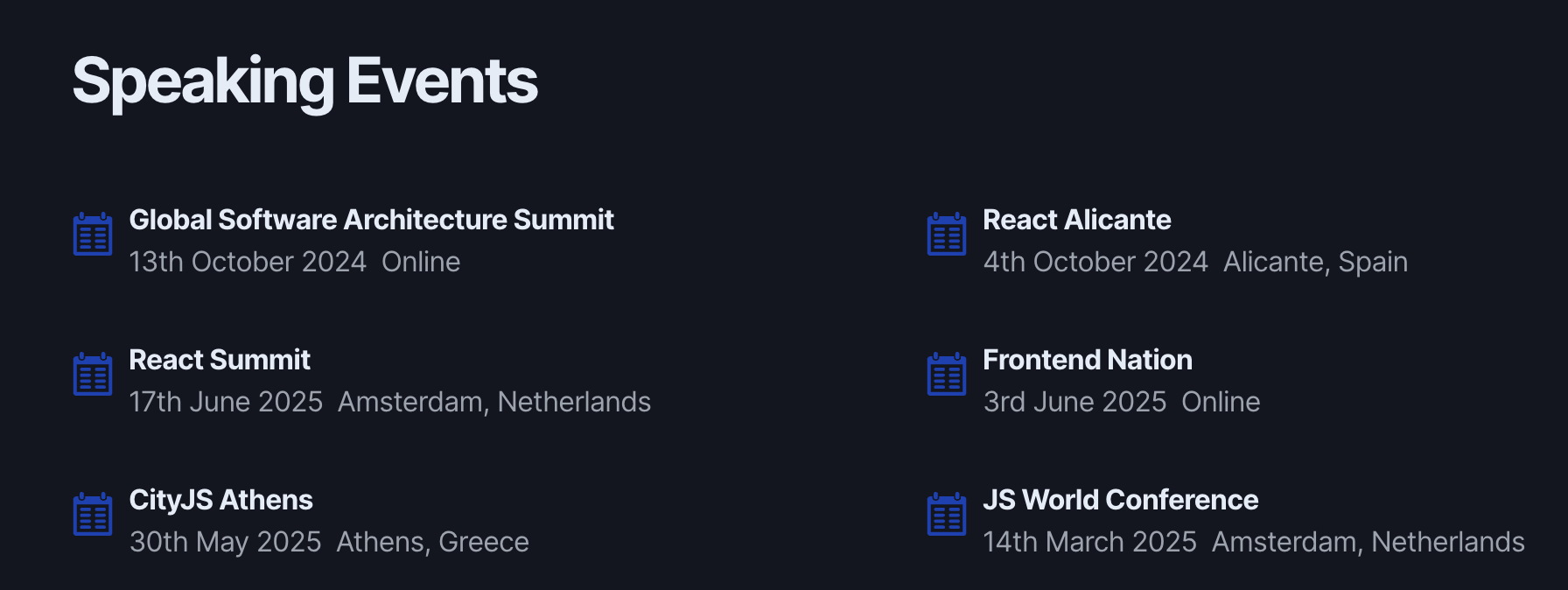
The biggest highlights for me:
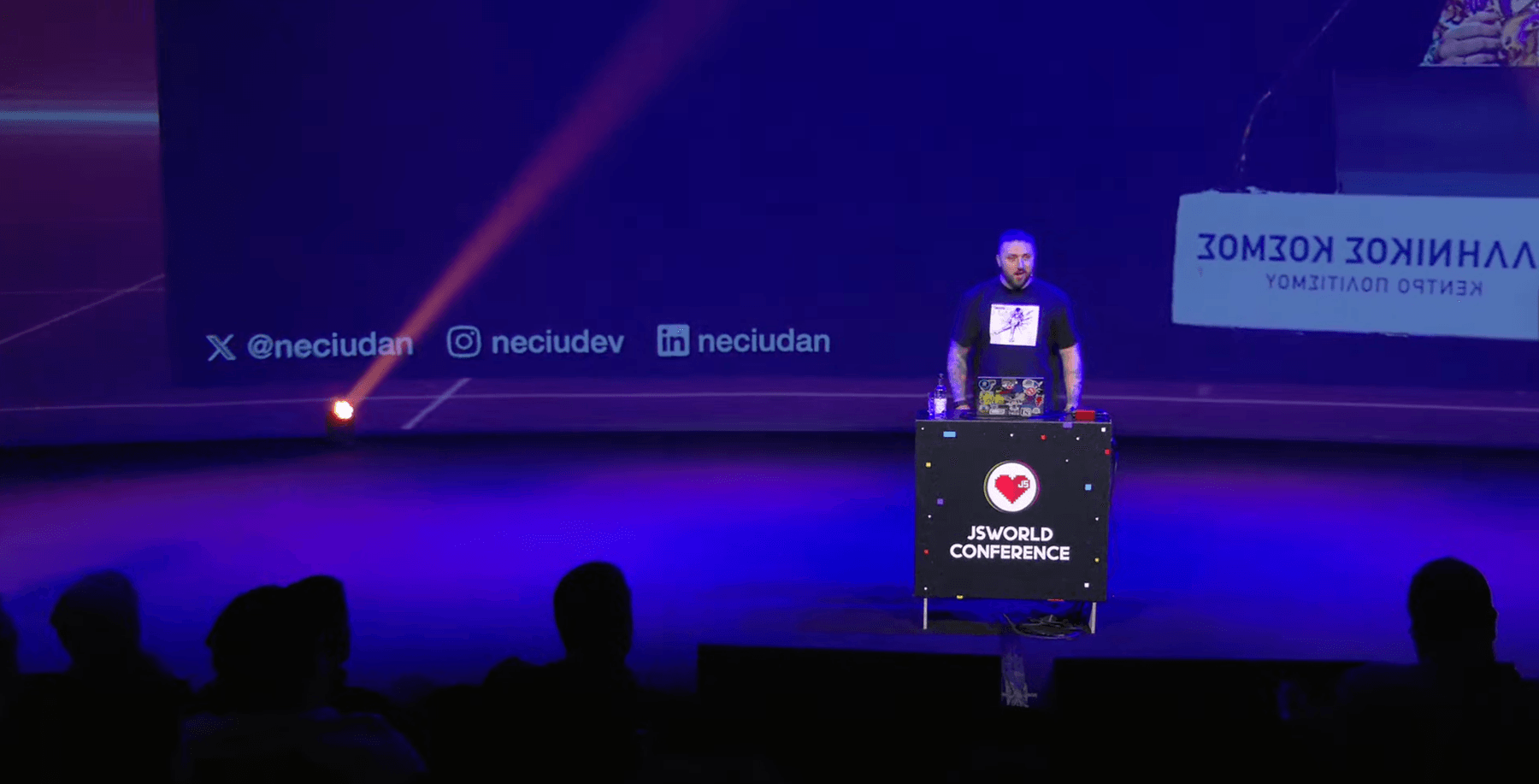
Speaking at JS World Conference, this stage is incredible, 1000 people in attendance, and a giant screen that opens up as you walk. This was also one of the first conferences I attended back in 2015, so going from attendee to speaker was such a huge high.
Better yet, I managed to share this experience with my good friend Fotis Adamakis, who pushed me to speak at conferences in the first place!
Another highlight of my confrence tour was speaking at CityJS for the first time, dunking on Aris, and meeting Faris Aziz – this man is a treasure, and he has helped me countless times with introductions for podcasts, conferences, and everything in between.
Getting to speak at conferences is still difficult (you have to apply, get accepted, agree on terms, etc.). Still, I think I’ve finally found the best conferences in Europe that I’ll keep applying to year on year: React Alicante, React Norway, JS Heroes, CityJS Athens & London, ZurichJS, Voxxed Days Athens & Zurich, Frontmania Utrecht, React Paris, JS World Amsterdam.
Plus a couple of outside Europe (React Miami, Render Atlanta, JS Summit New York, React Africa, and React Vegas, CityJS Signapore).
Some I already spoke at and loved the vibe, speakers, and organizers; some I will speak at in 2026 (more on that later); and some are still on the bucket list.
Fingers crossed for 2026!
Señors at Scale and the wonder of podcasting
I’ve been dreaming about starting a podcast for years, but something always got in the way. I was blaming my schedule, lack of video-editing knowledge, lack of professional equipment, and general procrastination.
Finally, I had a couple of conversations with people who host podcasts and got some first-hand feedback on what hosting one really entails. It was easy-peasy, they told me. Why? Because Riverside (a popular podcasting platform) does almost everything for you, and with the help of AI, you can handle the rest.
Color me intrigued. I created a list of some of my speaker friends or people I met at the ReactJS Barcelona meetup, and set up my first recording session. Then I scheduled four more to build a backlog of podcast episodes I can release every week.
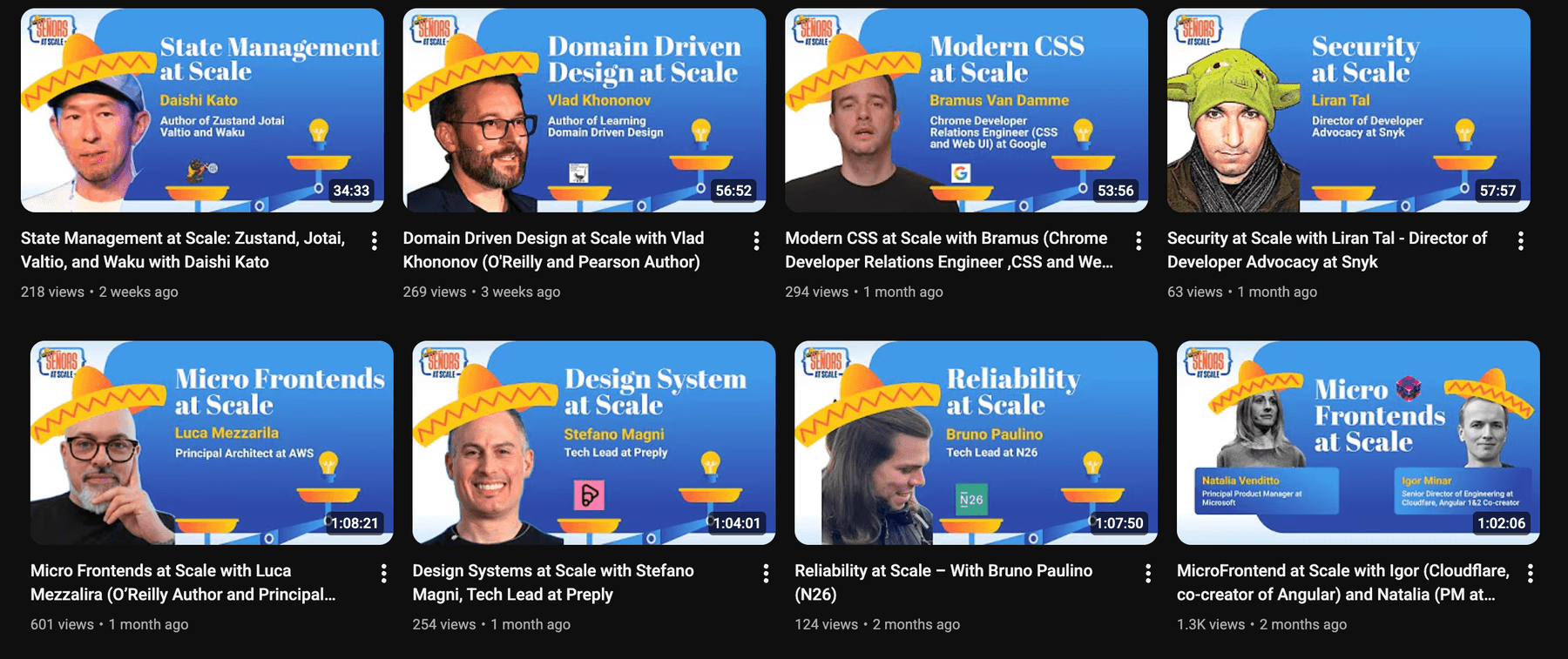
My goal was 20 episodes per year, released every Monday. If you do some quick maths, you might realize that I didn’t start in January 2025, due to the above reasons, it took me the first part of 2025 to prepare myself mentally and to get everything ready for the podcast, namely:
The name Señors @ Scale (a joke making fun of Señor and Senior developer play on words) The graphics needed for the podcast (logos, graphic cover, intro, and outro videos for the podcast) – Huge thanks to Stroe Adina for her fantastic work here Booking guests on the podcast Setting up a workflow
In general, my podcast boils down to four steps:
- Pre-recording, reaching out to guests, and booking a recording session, usually one hour
- Recording session and planning
- Post-production and posting the episode
- Marketing
Pre-recording step
I initially made a list of 20 people I wanted to have in the first season and then got up the courage to actually ask them. Some said no, and that was okay; most said yes, which was terrific; a couple couldn’t find the time, and that was regrettable, but for that, we have season 2.
I learned a valuable lesson here on taking the leap and just asking people for a favour. A big part of why it took me so long to make the podcast was my fear of rejection or of reaching out to people.
It usually takes a couple of back-and-forths to get the date/hour booked on the calendar, but once that’s done, it rarely falls through (and when it does, it’s usually because of me).
I also GPT’ed a Google Doc with best practices for the guest on the microphone, lighting, podcast format, types of questions, etc. Here is an example
How did I choose my guests? As the name of the podcast implies, I was looking for people in senior roles (Staff or Principal) at large companies who handled high-impact features.
I started locally in Barcelona, and then reached out to fellow speakers I met at conferences. As the year progressed, I met new people and talked to them about doing the podcast.
Some were very close friends (Adrian Marin), some I have never met before but reached out on LinkedIn (Luca Mezzarila), and the results speak for themselves: 20 posted episodes, two more in the backlog, and season 2 on the way.
Recording Session
I have a calendar notification set for 30’ before each recording. I use that time to get ready by setting up the lighting on my desk, checking the camera, opening Riverside studio, and waiting for the guest to join.
I played with the lighting, microphone, and camera angles, and finally got to a view I enjoy. I am still missing a professional camera and some better lights.
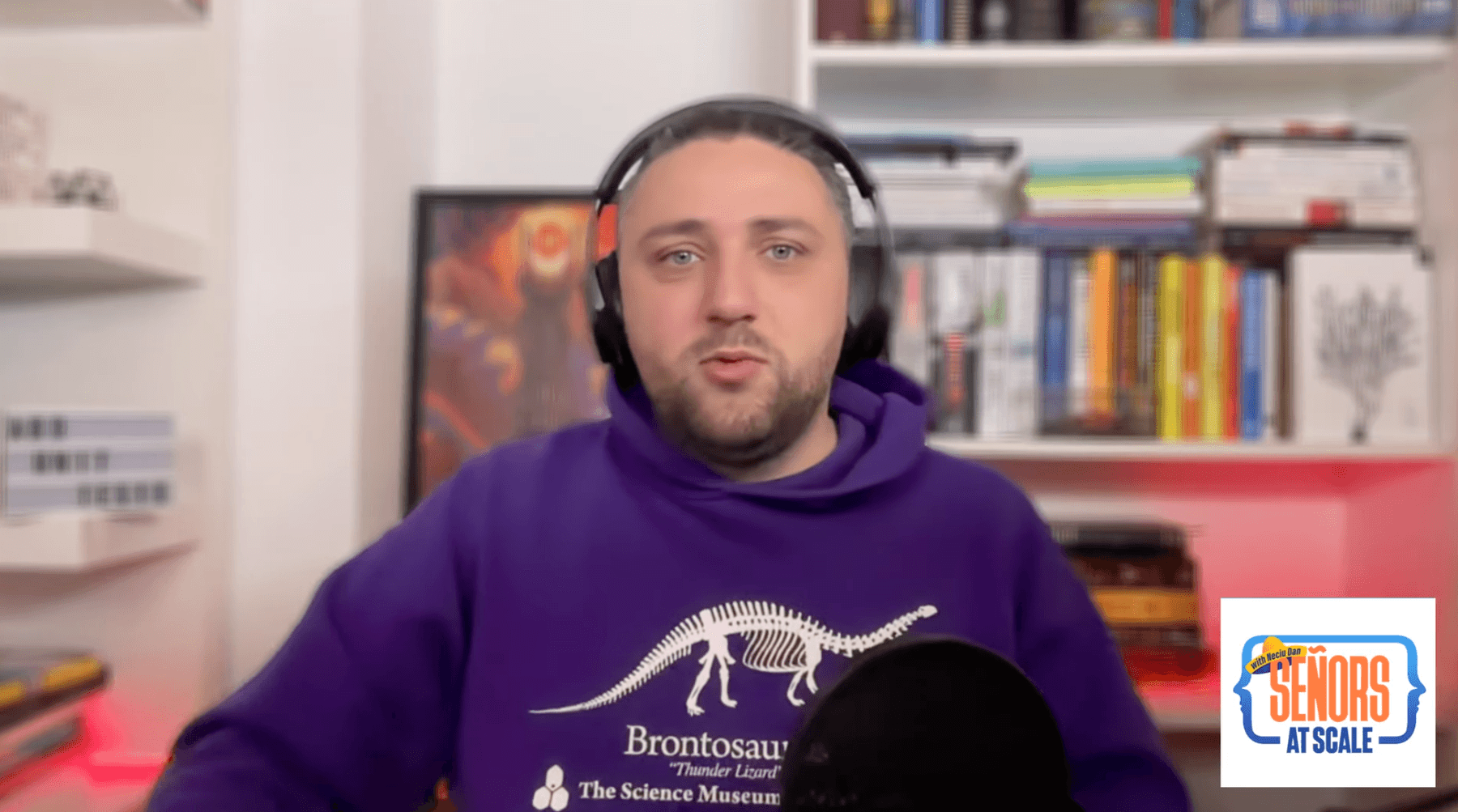
I also do some groundwork in those 30 minutes; I visit the guests’ LinkedIn pages and download their profiles as PDFs. I go to their blog/website and print it as a PDF. Finally, I write a quick memo on everything I personally know about the guest, then put all of these files into my custom-made GPT, which gives me an intro for this guest and a title for the episode.
Then I have a second GPT that generates 50 questions, broken down into five main topics, based on their history. I used these questions as a reference, I don’t usually go through half ot them. What usually happens is that I start with the guest’s history, how they got into programming, take small notes here and there to ask later, and focus on a lot of what they say, and then ask natural follow-up questions.
Take the episode with Erik about Observability at scale. While the plan was to discuss the ins and outs of Observability, the discussion naturally shifted to Micro Frontends and how they implemented a custom Micro Frontend architecture at New Relic.
I had a couple of hiccups during recording sessions with Kateryna while discussing Accessibility: my company’s app was experiencing an outage, and I had to call the recording short to take care of it. From that episode, I decided to turn off all notifications when recording.
Another incident happened after the Aris episode about Meetups and Conferences. After the recording session, it took a couple of minutes for the recording to upload to Riverside. Because Aris had a bad internet connection and closed the tab, I lost about half of the recording. (The other half just had my side asking questions and waiting for answers that never came, haha), So I had to cut the episode in half.
Post production
Every Sunday, after finishing scheduling my LinkedIn posts for next week, I get ready to finish the next episode of the podcast. Usually, I have 5-6 episodes already recorded, and I take the first recorded in line, usually by created_at, unless a specific trending topic is recorded.
First thing I do is download the transcript from Riverside, then I feed the transcript, episode name, and guest profile into a custom GPT to spit out 10 highlights for the trailer. (Word for word from the transcript, the GPT has instructions for each highlight to be 30-45 seconds long)
The GPT outputs text; I use that text to search Riverside for the section, split the recording at the start and end, then duplicate the section and move it to the beginning of the video before my Podcast Intro.
I do this 3-4 times, and I get my trailer in the beginning. Then I take advantage of Riverside AI capabilities: I add captions, remove filler words (uhms, ahms, mhm), and silence. Riverside has a cool feature that takes out the fluff after you review it (for example, if I mention in the podcast, “Don’t worry, we can cut this out, Riverside will find this and remove the section with my help). Then I apply smart layout (which changes the video screen based on who is speaking), podcast audio enhancement, and give it a first and final listen, removing anything that sounds wrong.
From this, I export two versions: the final full version and the opening trailer.
Riverside also has a Made For You section that generates 10 shorts for Instagram or TikTok. It also has a nice Virality score to help you choose which to post.
I started posting five short videos for each podcast episode. Still, I dropped down to one per week due to the effort involved and the return on investment; very few from Instagram/TikTok actually came to the episode.
Finally, I created the cover in Figma that I use as a thumbnail and cover in LinkedIn Announcement, and use another GPT to generate takeaways, which I use in my LinkedIn announcement post.
For this, I have a predefined cover already in use; I just change the text/image and export it. (Again, huge thanks to the Stroe sisters* Oana Stroe and Adina Stroe for the help here)
- They are not actually sisters (just a common last name), and Oana is actually my wife, who helps me out a ton.
Finally, I publish the episode myself on YouTube and Spotify for Creators (I don’t use Riverside auto-publish because it messes up some things)
I use a final GPT to generate YouTube/Spotify Descriptions using notes from Riverside, the transcript, and episode takeaways.
Spotify for Creators automatically pushes to other streaming platforms, including Apple, Amazon, and more.
And we’re live!
Marketing
Up until this point, it was easy! HA! Now the hard part. It’s Monday, I published the episode on all platforms and posted an announcement on LinkedIn (The guest usually reposts this or makes a post of their own), which generally gives the post around 1000 impressions, which is almost double what I get for posts where I put a link in the post.
With my usual subscribers and the LinkedIn post, I have around 50ish views across platforms for this episode.
Then on Tuesday, I post on my other socials: X, Instagram, Twitter, Bluesky, tagging the guest in each, hoping for some engagement – which I don’t get. (Besides the episode from Igor and Natalia about Web Fragments, where we discuss the controversial topic of Micro Frontends and Module Federation)
By now, we are closing in on 100 views / listens across platforms.
Wednesday morning, I create a custom Slack/ Discord message and post it in multiple Slack communities I am part of – depending on the topic of the episode. In the afternoon, I create a custom Reddit post, and I post it on /r/webdev or /r/reactjs or /r/programming ( I don’t use AI for these, and I try not to self-promote as much as possible – I was already banned from 4 communities)
Usually, we pass the 150 views at this point.
Thursday is my ace in the sleeve, I send my newsletter with the episode takeaways and call to action to listen to the episode. Normally, people subscribed here are already subscribed to my YouTube channel as well, but I have an 80% open rate and a 5% click rate, which gives us around 50-60 more views.
Friday, another Reddit post, cross-posting, some retweets. On Sunday, I post another LinkedIn post that mentions the takeaways and links to the episode again.
On average, all my episodes gravitate around the 300 views/listens mark, with many listens being full-episode listens, which is a great success. One of my main inspirations and competitors (Tejas, podcast ConTejas – give it a listen, it’s incredible) has around 300-500 views/ listens and around 5k subscribers, compared to my 1.2k.
Two episodes were outliers: the previously mentioned episode about Web Fragments, which passed 1.5k views, and the one about Micro-Frontends with Luc, which is closing in on 1k views.
I am super happy with how the podcast turned out. My initial goal was to reach 200 views per episode, which I easily surpassed. I was hoping for more YouTube subscribers, but each episode brings in around 40-50 new subscribers.
After my post on Sunday, I give myself a pat on the back for a week well done, then I start on the next episode.
You can check out all episodes on YouTube, Spotify, or Apple Music. Don’t forget to subscribe!
Failures, Future wishes, plans, and goals for 2026
Not everything was peachy, as LinkedIn Posting and Señors at Scale, some things failed to pick up, either with bad results or my own failure to do it.
⛔ Becoming a Social Media Video Influencer. Failed!
The main ones were YouTube, Instagram, and TikTok. I planned on making short reel content about programming and coding. I already had the content (My LinkedIn posts) and knew which ones worked and which didn’t, so the plan was to reuse the most successful posts and create some short videos.
Unfortunately, most of them barely got any views. I tried Trial reels, posting at different times, A/B testing covers, but none of them worked. Eventually, I had to face the truth that the video content was just not that good, so I hired someone to add B-roll (background footage) to my content.
The results are still in progress, but they are not looking good. Only one video got 15k+ views while the rest are mediocre at best.
I also tried some ads, for both TikTok and Instagram, and realised they DO NOT WORK. Sure, I get views and likes, but they feel fake; all the followers I get from paid content are 90% bots or just people who don’t know what they are doing. So I made a promise to myself to never use ads on Instagram and TikTok again.
BUT I am not giving up. Next year, I am going to double down and post one short reel per week. I plan to apply my podcast strategy of maintaining a 5-6 video backlog and improve my recording and video editing.
⛔ Write 12 articles per year. Failed!
Another goal of mine was to write. Articles. Tech articles.
I started the year with a big plan to move my blog from Medium to my own platform, which I built with Astro. Huge success.
Then I planned to write one tech article per month, for a total of 12. I wrote three.
There is no excuse here; I just didn’t get to it. I am happy with the three articles I did write, and I had so many article ideas, but sitting down to write (without AI) is just tricky.
I get rejuvenated in December when I have free time (hence this big ass article you are reading now) and hope next year will be so much better.
⛔ Failing just a little
I also had some partial failures:
- Organized nine meetups instead of 12
- Speak at five conferences instead of 6 Write a book (not even started lol)
- Finish a course (finished, but it turned out badly, a story for another time)
All in all, it was a year with mixed results that I am pleased about. The bad just keeps me going, motivates me to do more, get better, and live another day.
Given that, I set some high expectations for myself, which I like. I am a big fan of the 70% goal OKR strategy: if you achieve more than 70%, your goals were not audacious enough.
🚀 Goals
So here are my goals for 2026:
- 5x my newsletter audience from 1k to 5k subscribers
- 2x my LinkedIn Following from 10k to 20k
- 4x my YouTube Subscribers from 1.25k to 5k
- 10x my Social Media followers (Instagram and TikTok from 500ish to 5k) – Super audacious
- Write 12 articles
- Write a book
- Speak at six conferences
- Host 12 ReactJS Barcelona meetups
- Finish season 2 of Señors at Scale (20 episodes)
- Don’t get fired
- Don’t get divorced
Seems like a solid plan, I particularly care about the last one.
Wish you a happy New Year as well. Thank you for reading and being part of my journey. I hope all your goals, wishes, and plans come true in 2026, and most importantly, don’t give up. Remember that life is a roller coaster, and for every downhill we are facing, there are plenty of uphills we have to push the cart towards.
Let’s fucking do this! 🚀🚀🚀

Discover more from The Neciu Dan Newsletter
A weekly column on Tech & Education, startup building and occasional hot takes.
Over 1,000 subscribers


